

Putting on My Arab Identity for the Sake of Christ
What does it look like to change yourself outwardly for the sake of the gospel while firmly rooted in who you truly are in Christ? Christar worker Christina shares about the struggle and the truth that centered her during her time in the Middle East.
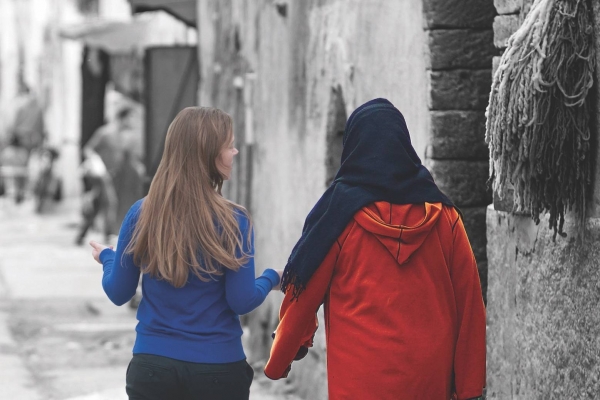
My language teacher and I were deep in conversation. Well, I wish. More accurately, she was monologuing as I attempted to keep up and respond appropriately to her questions and comments with my very limited Arabic. As we sauntered arm in arm down the dusty Middle Eastern street past the bakery, tea stand, roasted chicken shop, hookah shop and clothing shops that all seamlessly blended in concrete harmony, I did a great deal of “mhmm”-ing and made other understanding noises.
Suddenly, my teacher aggressively shushed me.
I was taken aback. She had cracked a silly joke, and I had laughed. What had I done wrong? What had I misunderstood? I was only four or five months into my time in the Middle East, and I was busy riding the culture shock roller coaster. My female Arabic teachers were my friends and culture guides.
As it turns out, it is not appropriate for women to laugh in public, and in laughing a big American laugh, I had drawn the attention of others on the street. There, it’s believed that if a man looks at a woman and stumbles, she is the one at fault because she should have been more respectable. Unsurprisingly, therefore, drawing attention to yourself as a woman is taboo and shameful.
When I moved to the Middle East, I knew gender roles, rules and norms would be quite different than what I was used to. What I did not realize until I lived there, however, was that these standards differed at every level—country, city, neighborhood, family. Part of my cultural integration was learning what I should and should not do or say as a single woman—and if I should, how I should—depending on who I was talking to, who was present nearby and where I was. My actions affected my honor and reputation as a woman, an American and a Christ-follower.
I knew there would be many adjustments and challenges, but I could not have been prepared for the defensiveness that rose to the surface every time a part of “me” was identified as shameful. I liked to laugh. Inappropriate. I wore jeans, a t-shirt and a cardigan. Immodest. I handled challenges on my own. Too independent. I smiled at men and women when I passed them in the street or saw them at the market. Inappropriate. I asked men and women, “How are you?” when I learned to do so in Arabic class. Inappropriate.
My best attempts seemed to fall flat, and I ran on a hamster wheel of failure, inadequacy and incompetence. It felt like everything I did was wrong, and therefore, I was wrong. I was not enough.
It takes a great deal of effort to be regularly told that so many things about you are shameful without internalizing that message or growing bitter. Through the prayers of my daily prayer partners and by the grace of God, with time, I learned many of the culture’s nuances and rules. I learned to smile at men with no teeth, dress “modestly,” only laugh when indoors with closed windows and to ask only women how they are doing. I learned to blend in.
Paul says in 1 Corinthians 9:22b, “I have become all things to all people, that by all means I might save some” (ESV). Some days, I felt like a champion chameleon for Christ. I bridged cultural gaps, built relational capital and shared gospel truths. Other days, I felt like I had been swallowed alive, chewed up and spit out by this new context. For so many years, I’d struggled to figure out who I was and be okay with it, and now it seemed I was losing ground at record speed in this new patriarchal honor-shame society. The old lies declaring that I am somehow simultaneously not enough but also too much lurked around every corner.
In pre-field training at Christar, I learned that struggles and temptations in a home context are amplified in cross-cultural contexts. Fear, shame, lies, inadequacy, temptations and ethnocentrism clamor for attention. Satan does not need to have me thrown in prison and beaten to attack the Kingdom. He just needs to whisper in my ear.
And so, I must put on the armor of God: the belt of truth, breastplate of righteousness, shoes of the gospel of peace, shield of faith, helmet of salvation and sword of the Spirit. I must take every thought captive and hold it up to the light: “I lift up my eyes to the hills. From where does my help come? My help comes from the Lord, who made heaven and earth. He will not let your foot be moved; he who keeps you will not slumber.” (Psalm 121:1-3 ESV)
When I lift up my eyes, my Heavenly Father reminds me who He is and who I am. When I turn my eyes upon Jesus, I know that I am enough because He says I am enough. I can adjust externally because internally, this chameleon is fully known by Jesus.
Related Projects
Related Stories












_1623444031_600x400.jpg)




Related Resources


_1654032461_600x400.jpg)





_1583365425_600x400.jpg)